Guide
Unschooling vs Traditional Homeschooling: Key Differences
By Dr. Lisa Chen, Homeschool Education Researcher · Updated 2026-03-23
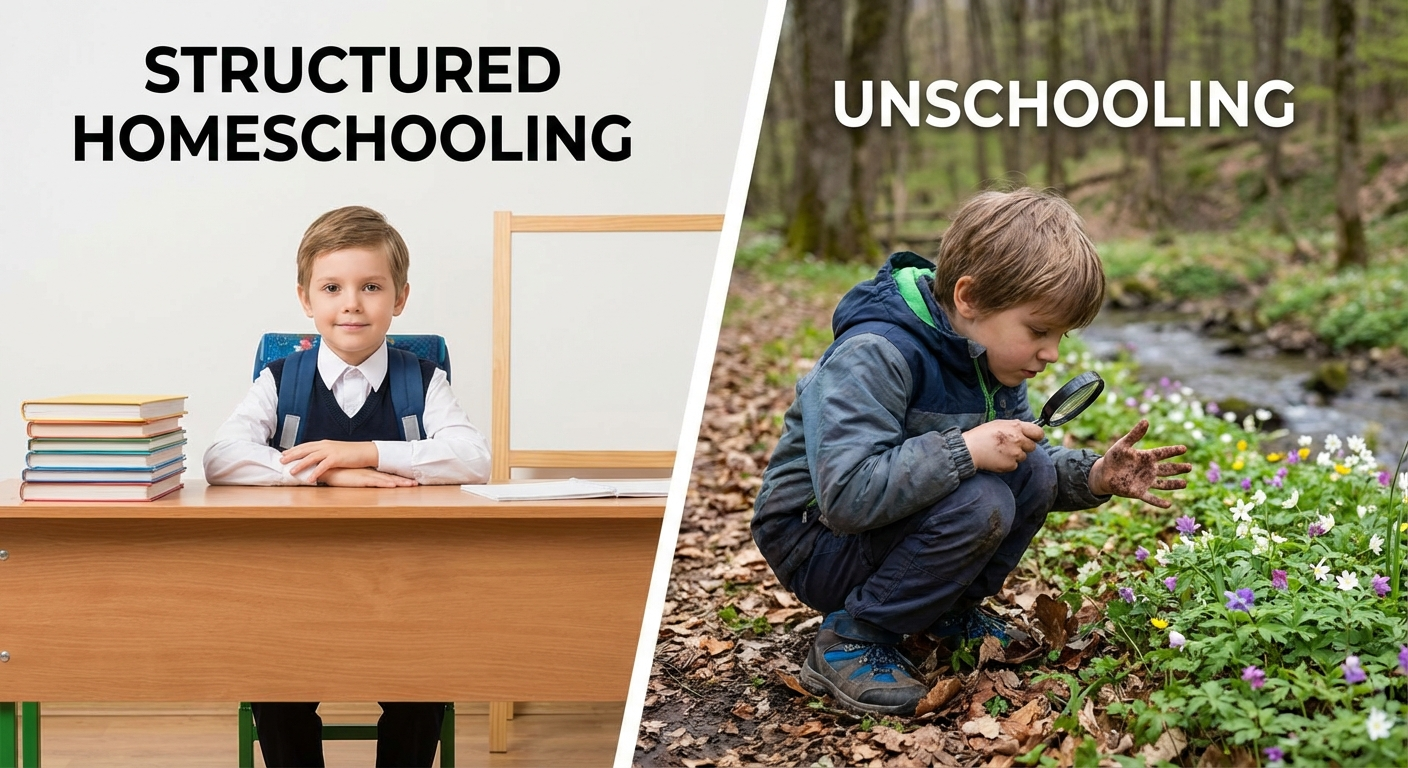
Unschooling and traditional homeschooling sit on opposite ends of the home education spectrum. Traditional homeschooling uses a structured curriculum with parent-led instruction, scheduled lessons, and measurable benchmarks. Unschooling is entirely child-directed — no curriculum, no grades, no forced lessons. Understanding the real differences between these two approaches helps you choose the method that matches your family's values, your child's temperament, and your state's legal requirements.
By Dr. Lisa Chen, Homeschool Education Researcher · Last updated: March 23, 2026
This article contains affiliate links. If you purchase through our links, we may earn a small commission at no extra cost to you. See our affiliate disclosure for details.
Visual breakdown: How unschooling and traditional homeschooling compare across schedule, curriculum, and assessment
Table of Contents
- Defining the Two Approaches
- Philosophy and Learning Theory
- Daily Life: What Each Approach Looks Like
- Curriculum and Resources Compared
- Academic Outcomes and College Readiness
- Cost Comparison
- Legal Considerations by State
- Socialization in Both Models
- The Hybrid Approach: Combining Both Methods
- Recommended Resources for Each Approach
- Frequently Asked Questions
- Sources
Defining the Two Approaches
Before comparing these methods, we need clear definitions. The terms get misused constantly online, and the confusion leads families to dismiss approaches that might actually work for them — or adopt approaches they fundamentally misunderstand.
What Is Traditional Homeschooling?
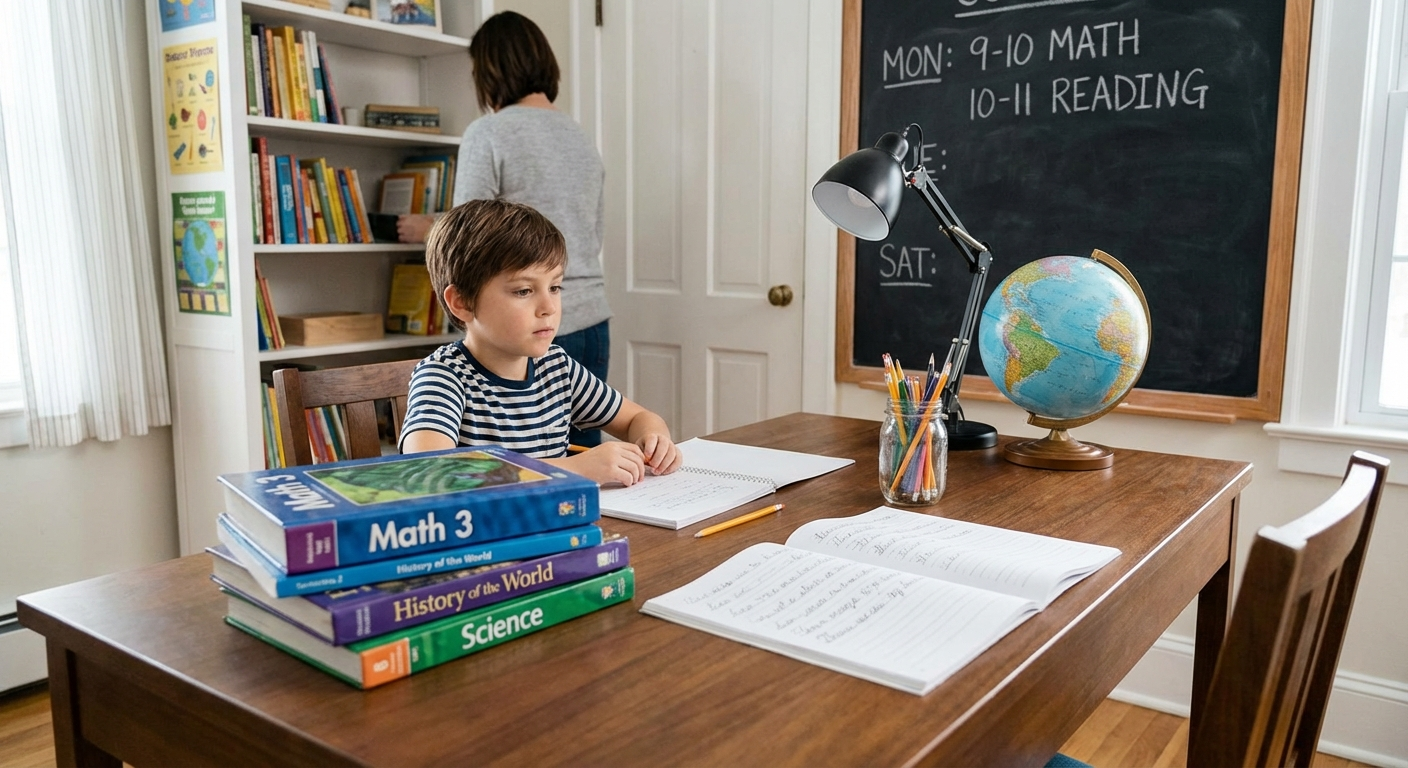
Traditional homeschooling replicates the core structure of classroom education at home. A parent selects a curriculum — either an all-in-one package or a combination of subject-specific programs — and delivers instruction on a set schedule. Students complete assignments, take tests or assessments, and progress through grade levels in a sequence similar to public or private schools.
The parent serves as the primary teacher. Lesson plans, textbooks, workbooks, and grading rubrics drive the day. Many traditional homeschool families follow a 180-day school year and keep detailed records of coursework completed.
Traditional homeschooling is what most people picture when they hear the word "homeschool." It is the most common approach in the United States, practiced by an estimated 60 to 70 percent of homeschooling families according to the National Center for Education Statistics.
If you are exploring traditional curricula, our best homeschool curriculum for 2026 guide compares the top-reviewed programs by grade level.
What Is Unschooling?
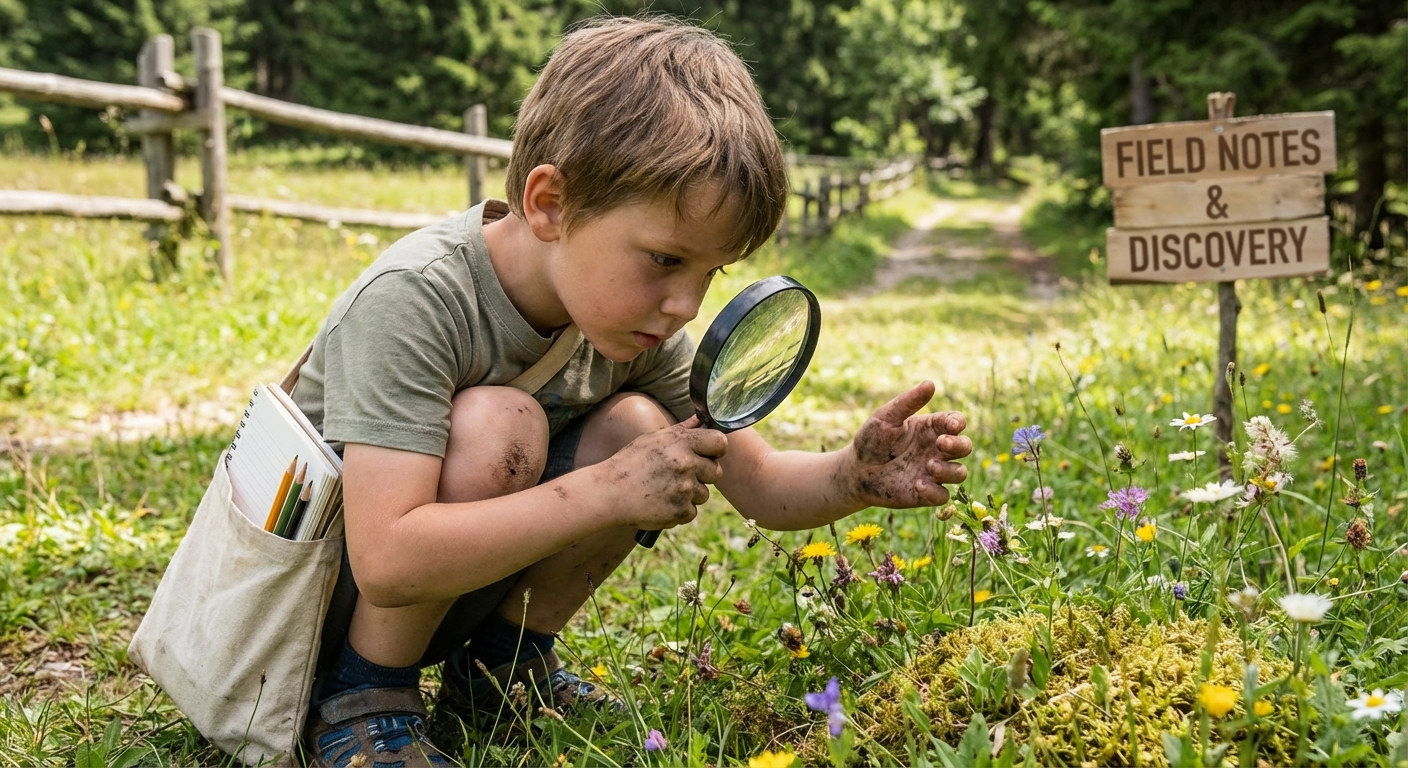
Unschooling rejects the idea that children need a prescribed curriculum to learn. Coined by educator John Holt in the 1970s, the term describes an approach where children direct their own education based on their curiosities, passions, and real-world experiences.
There are no textbooks unless the child requests them. No mandatory subjects. No tests. No grades. The parent does not assign work — instead, they facilitate learning by providing resources, answering questions, arranging experiences, and trusting that a child who is free to explore will naturally learn what they need to know.
Unschooling is not the same as neglect or "doing nothing." Effective unschooling requires deeply engaged parents who invest significant time and money creating rich learning environments. The distinction is that the child — not the parent, not a curriculum publisher — decides what to learn and when.
Philosophy and Learning Theory
The philosophical divide between these approaches is not merely practical — it reflects fundamentally different beliefs about how children learn best.
The Traditional Homeschool Philosophy
Traditional homeschooling draws from the same educational philosophy that underpins public schooling: learning is most effective when it is systematic, sequential, and guided by an experienced adult. Core assumptions include:
- Children need structure. Left to their own devices, most children will not spontaneously study algebra, grammar, or world history in a systematic way.
- Subject mastery builds on prior knowledge. Math concepts must be learned in order. Reading skills require explicit phonics instruction. A scope and sequence ensures no critical building blocks are skipped.
- Assessment drives accountability. Tests, quizzes, and graded assignments confirm that the child has actually absorbed the material — not just been exposed to it.
- The parent's role is to teach. The teaching parent is responsible for selecting appropriate material, delivering instruction, and ensuring academic progress meets or exceeds grade-level expectations.
This philosophy is heavily influenced by educators like E.D. Hirsch (cultural literacy), Siegfried Engelmann (Direct Instruction), and Charlotte Mason (living books, short lessons, narration).
The Unschooling Philosophy
Unschooling is rooted in the work of John Holt, who argued in books like How Children Learn (1967) and Teach Your Own (1981) that children are natural learners whose innate curiosity is often destroyed — not enhanced — by compulsory instruction.
Core assumptions include:
- Intrinsic motivation produces deeper learning. A child who wants to learn something will learn it more thoroughly and retain it longer than a child who is forced to study it.
- Real life is the curriculum. Cooking teaches fractions. Building a treehouse teaches geometry and physics. Running a lemonade stand teaches economics. Forced abstraction is unnecessary when authentic experience is available.
- Readiness matters more than age. A child who is developmentally ready to read at age 9 will learn in weeks what a child drilled at age 5 takes years to achieve. Pushing content before readiness creates frustration, not learning.
- The parent's role is to facilitate, not instruct. Parents observe, provide materials, ask questions, connect children with mentors, and trust the process.
This philosophy draws from constructivist learning theory (Piaget), self-determination theory (Deci and Ryan), and the Sudbury/democratic school model.
Where the Two Agree
Despite their differences, both approaches share critical common ground:
- Personalized education produces better outcomes than one-size-fits-all classrooms
- The parent-child relationship is central to effective learning
- Children benefit from spending less time sitting in desks and more time engaging with the real world
- Homeschooling in any form gives families the freedom to align education with their values
Daily Life: What Each Approach Looks Like
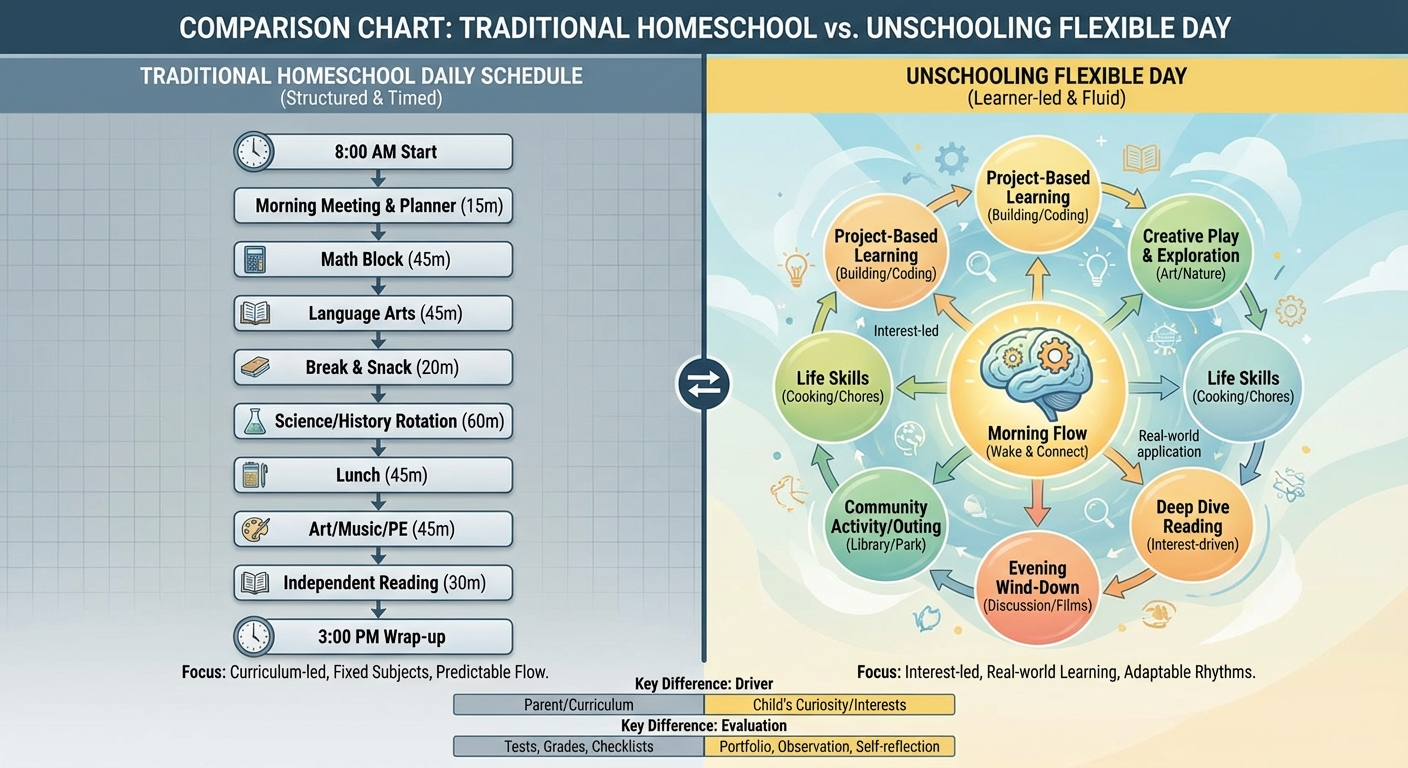
The most visible difference between unschooling and traditional homeschooling shows up in how each family spends a typical day.
A Typical Traditional Homeschool Day
Here is a representative schedule for a traditional homeschool family with a fourth-grader. For more schedule options by age, see our homeschool daily schedule templates.
| Time | Activity | Duration |
|---|---|---|
| 8:30 AM | Morning basket: read-aloud, calendar, memory work | 20 min |
| 8:50 AM | Language arts: grammar lesson + writing assignment | 40 min |
| 9:30 AM | Math: Singapore Math lesson + practice problems | 45 min |
| 10:15 AM | Break: snack + free play | 20 min |
| 10:35 AM | History: Story of the World chapter + narration | 30 min |
| 11:05 AM | Science: experiment or reading + notebook entry | 30 min |
| 11:35 AM | Art, music, or foreign language | 30 min |
| 12:05 PM | Lunch + afternoon free time | — |
Total structured academic time: 3–3.5 hours
The parent has prepped lessons the night before, knows exactly what pages to cover, and tracks progress against a yearly plan. The child knows what to expect each day. Transitions are smooth because the routine is established.
A Typical Unschooling Day
An unschooling day has no fixed structure. Here is what a day might look like for a 10-year-old unschooler — but tomorrow could look completely different:
| Time | Activity | Who Initiated |
|---|---|---|
| 9:00 AM | Wakes up, reads a graphic novel series about ancient Rome | Child |
| 10:00 AM | Asks parent questions about Roman aqueducts; they watch a documentary together | Child + Parent |
| 11:00 AM | Builds a model aqueduct from cardboard and tubes; tests water flow | Child |
| 12:00 PM | Lunch; plays a math-based video game | Child |
| 1:30 PM | Visits the library; checks out books on hydraulic engineering and Roman mythology | Parent-facilitated |
| 3:00 PM | Attends a weekly park meetup with other homeschoolers | Parent-arranged |
| 4:30 PM | Writes a story set in ancient Rome | Child |
| 6:00 PM | Helps cook dinner (measuring ingredients, following a recipe) | Family |
There is no "total academic time" because unschoolers do not separate learning from living. The ancient Rome rabbit hole covers history, engineering, physics, math, reading, writing, and social studies — the child just does not experience it as "school."
The Tension Point
Critics of unschooling ask: "What if the child never gets interested in algebra?" Unschooling advocates respond that math shows up naturally in cooking, budgeting, gaming, building, and dozens of other interests — and that a teenager who needs algebra for a specific goal will learn it faster and more willingly than a child forced through it at age 12.
Critics of traditional homeschooling ask: "Why force a curriculum when it kills the love of learning?" Traditional homeschoolers respond that loving learning is not enough if you graduate without the math skills to balance a checkbook or the writing skills to compose a resume.
Both sides have valid points. The right answer depends on your child.
Curriculum and Resources Compared
Traditional homeschoolers rely on structured curricula. Unschoolers rely on living resources. Many families land somewhere in between. Here are the top resources for each approach — and for hybrids.
Top Resources for Traditional Homeschooling
Sonlight Complete Curriculum Package
Best for: Literature-loving families wanting an all-in-one traditional solution
Ages: K–12
Cost: $500–$1,200/year
Why it works: Replaces textbooks with real books. Detailed daily instructor guides eliminate lesson-planning time. Parent reads aloud with the child, creating strong bonds while covering history, science, and language arts.
Saxon Math
Best for: Families wanting rigorous, incremental math instruction
Ages: K–12
Cost: $50–$90/year per level
Why it works: Uses an incremental approach with constant review. Each lesson introduces one concept and spirals back to reinforce previously learned material. Produces strong standardized test scores consistently.
The Well-Trained Mind (Susan Wise Bauer)
Best for: Classical education families wanting a structured K–12 roadmap
Ages: K–12
Cost: $25–$40 (book); curriculum components vary
Why it works: Provides a complete classical education plan organized by the trivium (grammar, logic, rhetoric stages). Tells parents exactly what to teach, when, and with which resources. The gold standard for classical homeschoolers.
Teaching Textbooks (Math)
Best for: Independent learners; parents who struggle to teach math
Ages: Grades 3–12
Cost: $72/year per level (online subscription)
Why it works: Self-teaching math program with video explanations for every problem. Students can work independently while parents track progress through a dashboard. Dramatically reduces parent-teaching burden for math.
All About Reading / All About Spelling
Best for: Multisensory phonics and spelling instruction; children with dyslexia
Ages: PreK–Grade 6
Cost: $30–$120 per level
Why it works: Orton-Gillingham-based approach using visual, auditory, and kinesthetic methods. Includes letter tiles, readers, and activity sheets. One of the most effective phonics programs available for homeschoolers, especially for children who struggle with reading.
Top Resources for Unschooling Families
Unschoolers do not use formal curricula, but they do invest heavily in resources that support self-directed exploration:
John Holt's "Teach Your Own" (Revised Edition)
Best for: Parents new to unschooling who want to understand the philosophy
Format: Book
Cost: $12–$18
Why it matters: The foundational text for the unschooling movement. Holt lays out the case for trusting children's natural learning instincts and provides practical guidance on facilitating education without curriculum. Essential reading before starting.
Free to Learn by Peter Gray
Best for: Understanding the scientific research behind self-directed learning
Format: Book
Cost: $14–$18
Why it matters: Boston College psychologist Peter Gray synthesizes decades of research showing how play-based, self-directed learning produces better outcomes than forced instruction. Provides the scientific backing that Holt's work laid philosophically.
Snap Circuits Electronics Exploration Kit
Best for: Hands-on STEM exploration for curious builders ages 8+
Format: Physical kit
Cost: $35–$75
Why it matters: Unschoolers thrive with open-ended, hands-on materials. Snap Circuits lets children build working electronic circuits — fans, alarms, radios — without any instruction from a parent. The child explores physics, engineering, and problem-solving naturally through play and experimentation.
Khan Academy (Free)
Best for: Self-paced learning when an unschooler decides to fill a knowledge gap
Format: Online platform
Cost: Free
Why it matters: When an unschooled teenager realizes they need algebra for a robotics project or SAT prep, Khan Academy lets them learn it on their own terms, at their own pace, with zero pressure. It is the unschooler's safety net for systematic subject coverage.
The Unschooling Handbook by Mary Griffith
Best for: Practical day-to-day guidance on implementing unschooling
Format: Book
Cost: $10–$16
Why it matters: Where Holt provides philosophy, Griffith provides practice. Covers how to handle relatives who question your approach, how to document learning for state requirements, and how to create resource-rich environments that naturally lead to deep learning.
Academic Outcomes and College Readiness
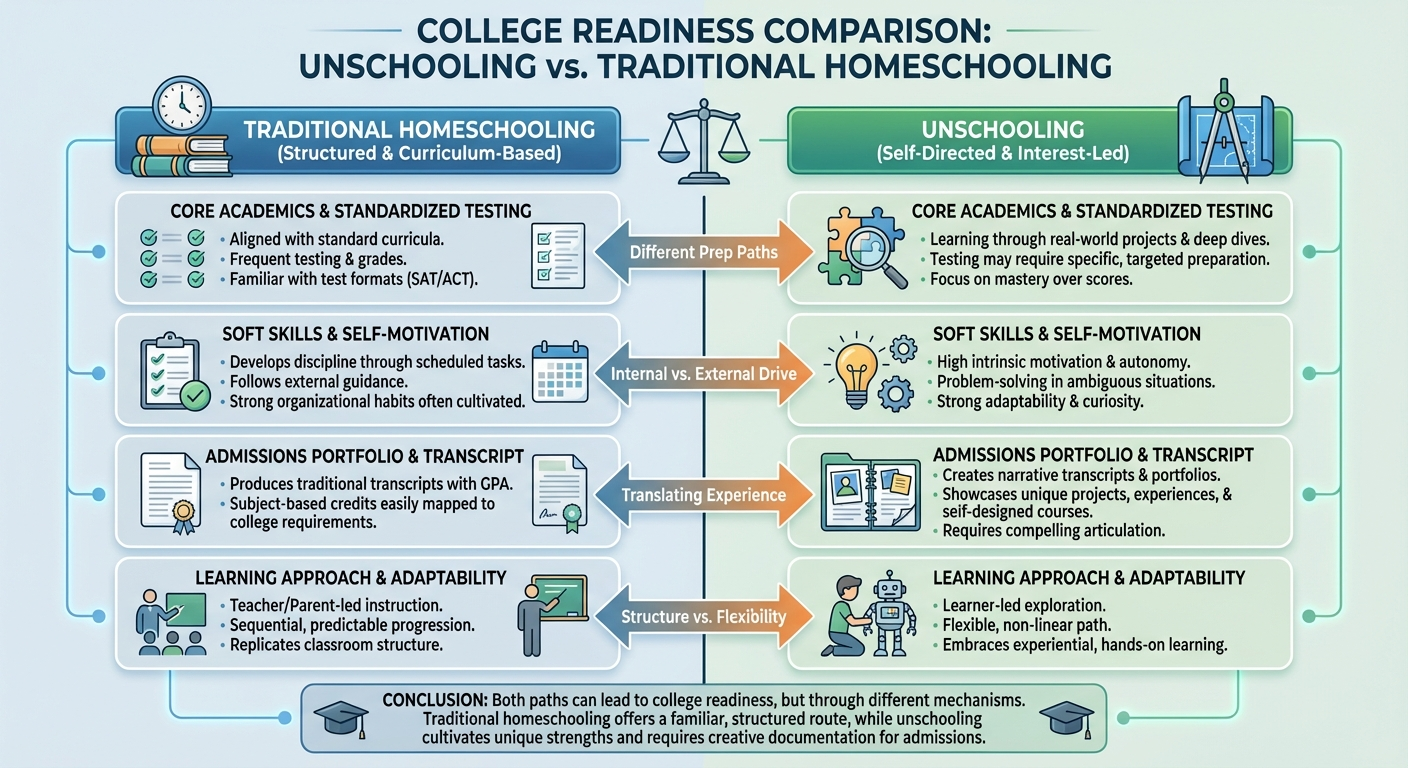
This is the question that keeps parents up at night: will my child actually learn what they need to learn?
Traditional Homeschool Outcomes
The data here is relatively strong. The National Home Education Research Institute (NHERI) has published multiple studies showing that traditionally homeschooled students score 15 to 25 percentile points above public school averages on standardized tests. A 2024 review by Dr. Brian Ray found that homeschooled students scored in the 67th to 88th percentile across core subjects, compared to the 50th percentile for public school students.
College acceptance rates are high. Harvard, MIT, Stanford, and all Ivy League schools actively accept homeschool applicants. Many homeschooled students enter college with dual-enrollment credits already completed.
Strengths of traditional homeschool outcomes:
- Strong standardized test performance
- Clear transcripts that colleges understand
- Systematic coverage of all core subjects
- Easy to demonstrate grade-level progress
Potential weaknesses:
- Risk of teaching to the test rather than deep understanding
- May produce compliance without genuine intellectual curiosity
- Children may struggle with self-direction in college if always told what to study
Unschooling Outcomes
Research on unschooling outcomes is more limited but growing. The most frequently cited study is Peter Gray and Gina Riley's 2013 survey of 232 grown unschoolers, published in the Journal of Unschooling and Alternative Learning. Key findings:
- 83% had pursued higher education (college, vocational training, or self-directed professional education)
- Most reported feeling well-prepared for college and career
- The most commonly cited benefits were self-motivation, love of learning, and independence
- The most commonly cited challenge was adjusting to the structure of formal academic settings
A follow-up 2019 study by Gray and Riley found similar patterns, with grown unschoolers disproportionately represented in creative fields, entrepreneurship, and STEM careers.
Strengths of unschooling outcomes:
- Intrinsic motivation and self-direction
- Deep expertise in areas of passionate interest
- Strong problem-solving and independent thinking skills
- High reported life satisfaction and love of learning
Potential weaknesses:
- Possible gaps in subjects the child never explored
- Transition to structured college coursework can be jarring
- Limited standardized test data makes outcomes harder to measure
- Depends heavily on parental engagement and resource availability
The Honest Assessment
Neither approach guarantees success. A well-executed traditional homeschool education produces academically strong, well-rounded graduates. A well-executed unschooling experience produces self-directed, deeply curious lifelong learners. A poorly executed version of either — neglectful unschooling or rigid, joyless traditional schooling — produces struggling children.
The execution matters more than the method.
Cost Comparison
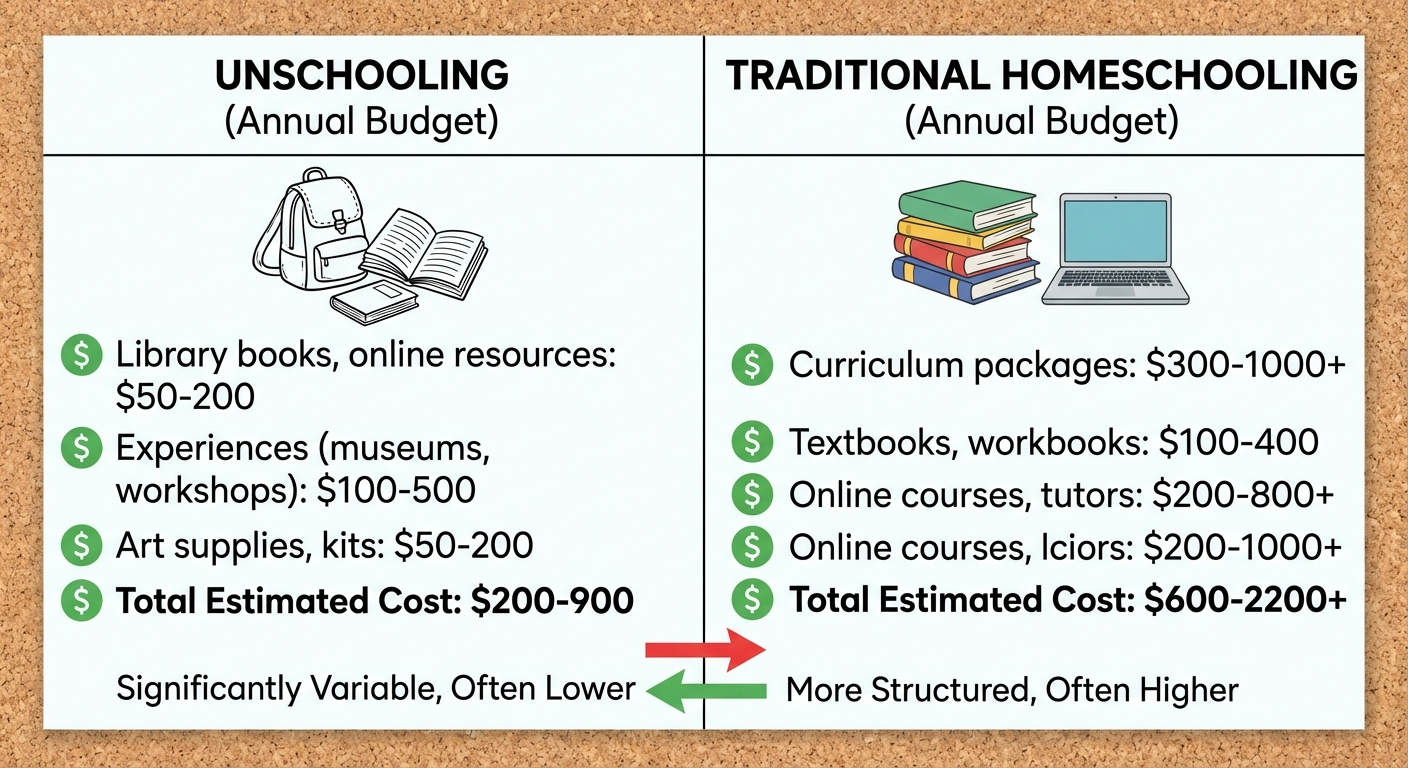
One of the most common misconceptions is that unschooling is free because you do not buy a curriculum. In reality, both approaches cost money — they just spend it differently.
Traditional Homeschooling Costs
| Expense Category | Annual Cost Range |
|---|---|
| All-in-one curriculum (e.g., Sonlight, Abeka) | $400–$1,200 |
| Individual subject programs (math, reading, science) | $100–$400 |
| Workbooks, test booklets, and consumables | $50–$150 |
| Standardized testing (if required) | $25–$75 |
| Co-op or group class fees | $100–$500 |
| Supplies (art, science, general) | $50–$200 |
| Total typical range | $500–$2,000/year |
Many families reduce these costs by buying used curriculum, sharing resources through homeschool co-ops, and using free programs like Khan Academy for supplementation.
Unschooling Costs
| Expense Category | Annual Cost Range |
|---|---|
| Books, magazines, and library fees | $100–$500 |
| Museum, zoo, and science center memberships | $100–$400 |
| Classes and workshops (art, music, coding, sports) | $200–$1,500 |
| Hands-on materials and kits (electronics, craft, building) | $100–$600 |
| Travel and field experiences | $200–$2,000+ |
| Online platforms and subscriptions | $50–$300 |
| Total typical range | $500–$3,000+/year |
Unschooling can be done inexpensively using libraries, free community resources, and nature. But families who invest in rich experiences — travel, specialized classes, quality materials — often spend more than traditional homeschoolers.
The Hidden Cost: Parent Time
Both approaches require a stay-at-home or flexible-schedule parent, which represents the largest cost for most families — lost income. Traditional homeschooling typically requires 3 to 5 hours of direct instruction and prep time daily. Unschooling requires constant availability and engagement, though not structured "teaching time." Neither approach is compatible with hands-off parenting.
Tracking your time commitments across approaches can be valuable. Many homeschool families find that daily habit tracking for homeschool routines helps them understand where their hours actually go and identify patterns for improvement.
Legal Considerations by State
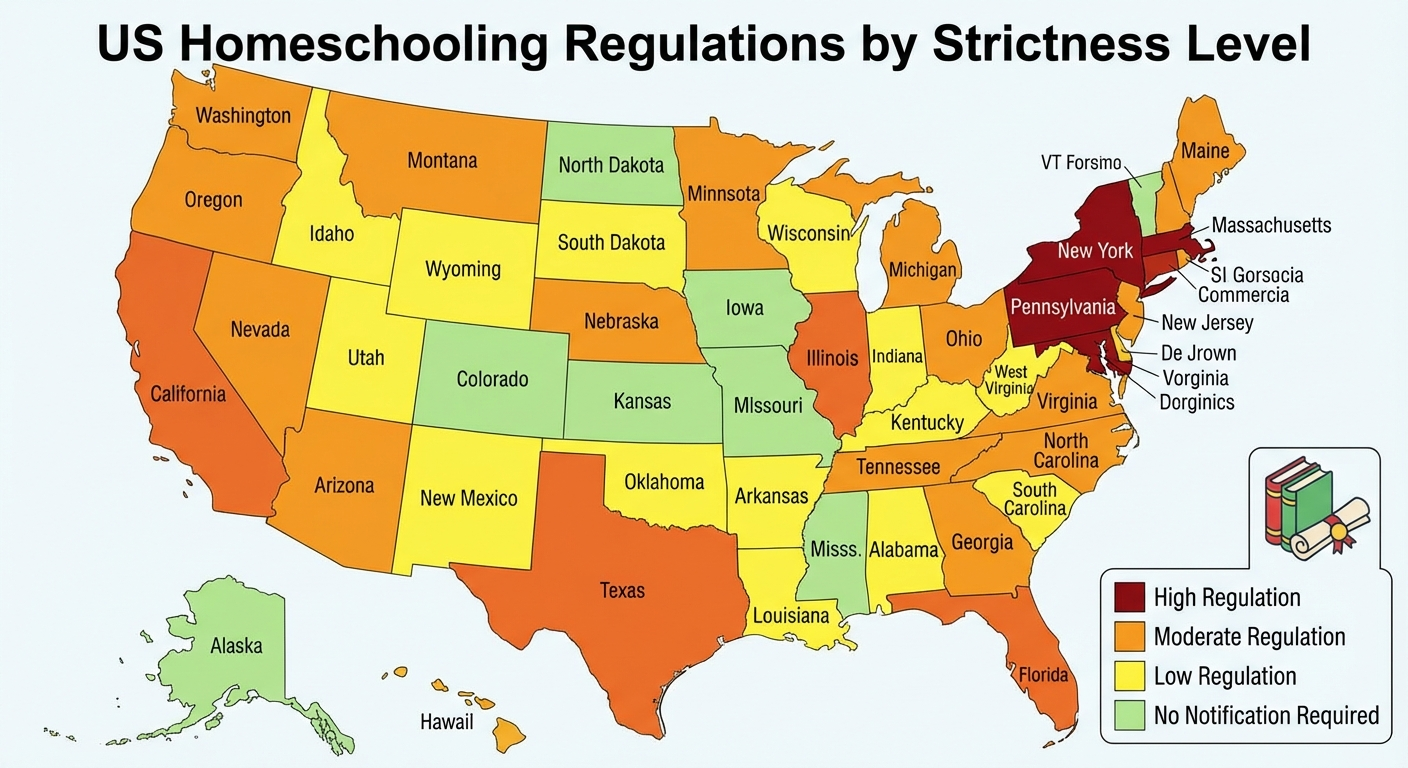
Both unschooling and traditional homeschooling are legal everywhere in the United States, but state regulations affect each approach differently.
How Regulation Levels Affect Each Approach
States fall into four general categories of homeschool regulation, as classified by the Home School Legal Defense Association (HSLDA):
No notice required (11 states including Texas, Alaska, Idaho):
- Traditional homeschooling: No restrictions or reporting
- Unschooling: No restrictions or reporting — easiest states for unschoolers
Low regulation (15 states including California, Nevada, Missouri):
- Traditional homeschooling: Must notify the state; minimal additional requirements
- Unschooling: Notification is simple; no curriculum review or testing
Moderate regulation (18 states including Colorado, Florida, Oregon):
- Traditional homeschooling: Must submit test scores or professional evaluations periodically
- Unschooling: Must demonstrate progress, which requires creative documentation — portfolio reviews showing project work, reading logs, and skill demonstrations
High regulation (6 states including New York, Pennsylvania, Vermont):
- Traditional homeschooling: Annual submission of curriculum plans, quarterly reports, standardized testing
- Unschooling: Requires the most creative compliance — Individualized Home Instruction Plans (IHIPs) that frame child-led exploration in academic language; annual assessments that may require test prep
Practical Compliance Tips for Unschoolers
If you live in a high-regulation state and want to unschool, here is how experienced families handle it:
- Keep a daily log. Jot down what your child did each day in broad subject categories. "Built a birdhouse" becomes "Applied measurement, geometry, and woodworking (math, science, vocational)."
- Photograph everything. Projects, experiments, field trips, books read, games played. Visual documentation is powerful evidence of learning.
- Use retroactive curriculum mapping. At the end of each quarter, map your child's activities to subject areas. You will be surprised how much ground they covered naturally.
- Connect with local unschooling groups. Experienced unschoolers in your state know exactly what evaluators expect and how to present child-led learning in compliant terms.
Socialization in Both Models
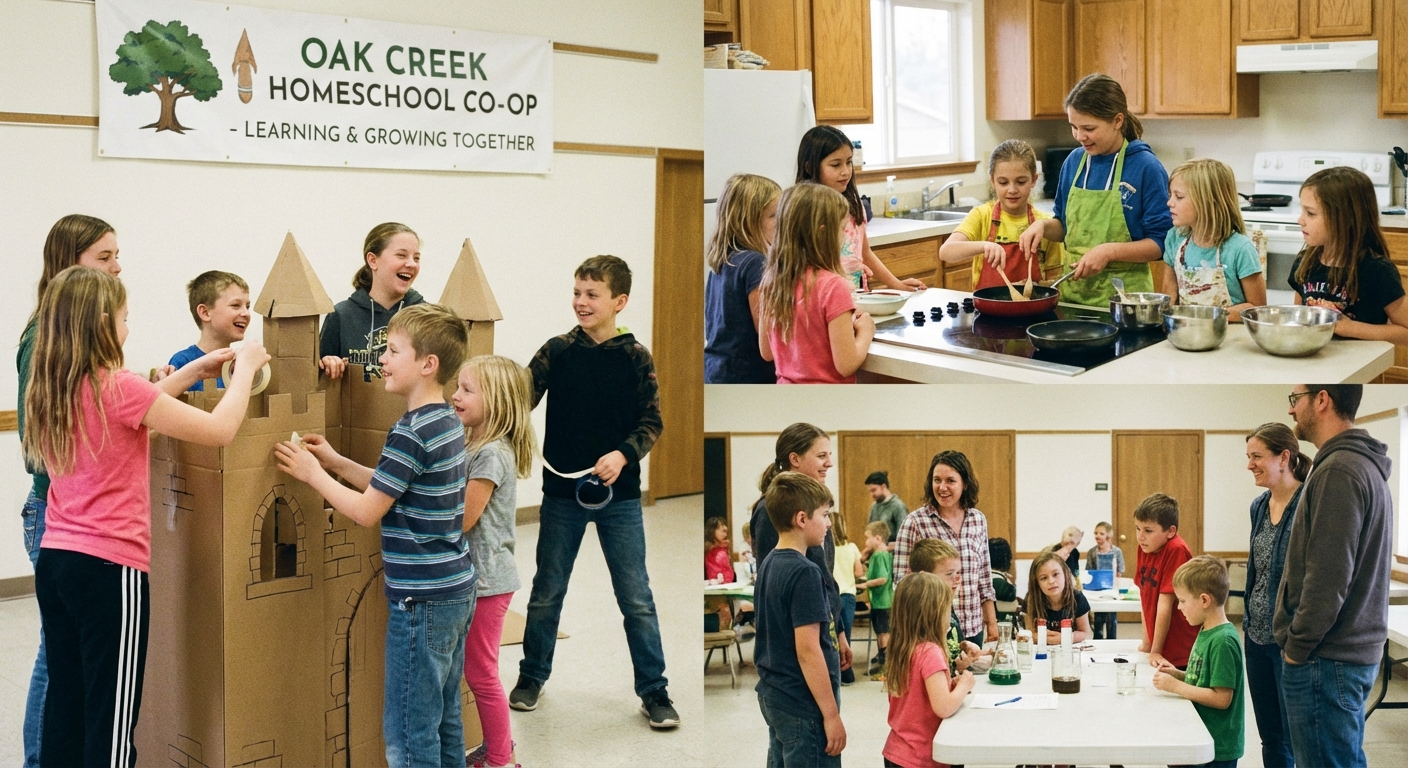
The "What about socialization?" question follows every homeschool family regardless of method. Here is how each approach handles it.
Traditional Homeschool Socialization
Traditional homeschooling families typically build social lives through:
- Homeschool co-ops — Weekly or biweekly group classes where children learn alongside peers. Co-ops often include science labs, art classes, public speaking, and PE. See our guide to the best homeschool co-ops for finding one near you.
- Sports leagues and extracurriculars — Community sports, dance, martial arts, Scouts, 4-H, and church youth groups
- Academic competitions — Spelling bees, geography bees, math olympiad, science fair, debate clubs
- Dual enrollment — High school students taking community college classes alongside traditionally schooled peers
Unschooling Socialization
Unschooling families tend to prioritize organic, interest-based social interactions:
- Interest-based communities — If the child loves robotics, they join a robotics club. If they love theater, they join a community theater group. Friendships form around shared passions.
- Mixed-age interactions — Unschoolers spend time with people of all ages — younger children, older teens, adults, seniors — rather than exclusively with same-age peers. Advocates argue this mirrors real-world social dynamics more accurately.
- Community involvement — Volunteering, apprenticeships, part-time work, and community projects
- Park days and meetups — Regular gatherings with other homeschool and unschool families for unstructured play and socializing
The Research on Homeschool Socialization
A 2021 study published in Peabody Journal of Education by Dr. Sandra Martin-Chang at Concordia University compared the social skills of homeschooled and conventionally schooled children. The study found that homeschooled children scored comparably on measures of social competence and had lower rates of behavioral problems. The type of homeschooling (structured vs. unstructured) did not significantly affect social outcomes — what mattered was the family's intentionality about providing social opportunities.
The socialization concern, while understandable, is largely a relic of a time when homeschooling was rare and isolated. In 2026, with an estimated 3.3 million homeschooled children in the U.S. and abundant community resources, social isolation is a choice, not an inevitability.
The Hybrid Approach: Combining Both Methods
Many families find that pure unschooling or pure traditional homeschooling does not fit their reality. The hybrid approach — sometimes called "eclectic homeschooling" or "relaxed homeschooling" — borrows the best elements of each.
Common Hybrid Models
Structured core + unschooled electives: The most popular hybrid uses formal curriculum for math and language arts (the two subjects where sequential skill-building matters most) while letting children direct their own learning in science, history, and the arts. This ensures baseline literacy and numeracy while preserving the motivation and depth benefits of self-directed exploration.
Unschooling with periodic benchmarking: The family lives an unschooling lifestyle 90 percent of the time, but the parent periodically assesses whether the child is developing age-appropriate skills. If significant gaps appear — for example, a 10-year-old who has never encountered multiplication — the parent introduces targeted resources without converting to a full curriculum.
Seasonal shifts: Some families use a structured curriculum during the traditional school year and unschool through summers and breaks. Others do the opposite — unschool during the busy family months and concentrate structured work into focused periods.
Grade-level transitions: It is common for families to unschool during the elementary years, when play-based learning is most developmentally appropriate, and introduce more structure in the middle and high school years as college preparation becomes relevant.
Making the Hybrid Work
The key to successful hybrid homeschooling is clarity about your non-negotiables. Ask yourself:
- Which subjects absolutely require structured instruction for my child? (For most families: math and reading)
- Which subjects would benefit from child-led exploration? (For most families: science, history, arts)
- What are my state's requirements, and how do I satisfy them?
- What is my child's temperament — do they thrive with structure, freedom, or a mix?
There is no rule that says you must pick one approach and stick with it forever. The families with the best outcomes are the ones who stay responsive to their child's changing needs.
Recommended Resources for Each Approach
Books Every Homeschool Parent Should Read
For traditional homeschooling:
- The Well-Trained Mind by Susan Wise Bauer — The definitive classical education roadmap
- Teaching from Rest by Sarah Mackenzie — Prevents burnout and perfectionism in structured homeschooling
- The Brave Learner by Julie Bogart — Brings joy and curiosity into curriculum-based learning
For unschooling:
- How Children Learn by John Holt — The foundational text on natural learning
- Free to Learn by Peter Gray — Scientific research supporting self-directed education
- The Unschooling Handbook by Mary Griffith — Practical daily guidance
For hybrid/eclectic approaches:
- Project-Based Homeschooling by Lori Pickert — Structured framework for child-led deep dives
- A Gracious Space by Julie Bogart — Creating an inviting learning environment regardless of method
Online Communities
- Traditional: The Well-Trained Mind forums, Homeschool Buyers Co-op, Classical Conversations Connected Community
- Unschooling: Unschooling Mom2Mom (Facebook), Sandra Dodd's website, the Alliance for Self-Directed Education
- Hybrid: Brave Writer Lifestyle community, Secular Eclectic Academic Homeschoolers (Facebook)
Frequently Asked Questions
What is the main difference between unschooling and traditional homeschooling?
The main difference is who directs the learning. Traditional homeschooling uses a parent-selected curriculum with structured lessons, grades, and schedules — similar to school at home. Unschooling is child-led, meaning the child pursues their own interests without formal curriculum, tests, or forced instruction. The parent acts as a facilitator rather than a teacher.
Is unschooling legal in all 50 states?
Unschooling is legal in all 50 U.S. states because it falls under homeschool laws, but compliance requirements vary significantly. States like Texas and Alaska have minimal oversight, making unschooling straightforward. States like New York and Pennsylvania require annual assessments or portfolio reviews, which unschooling families must still satisfy. Always check your state's specific homeschool statute before beginning.
Do unschooled children perform well on standardized tests?
Research is limited but suggestive. A 2019 study by Gray and Riley found that 83 percent of surveyed grown unschoolers had pursued higher education, and most reported being well-prepared. However, unschooled children who have never encountered test formats may score lower initially due to unfamiliarity with testing conventions rather than lack of knowledge. Families in states requiring testing often do brief test prep beforehand.
Can you combine unschooling and traditional homeschooling?
Yes, and many families do. A common hybrid approach uses structured curriculum for core subjects like math and language arts while allowing child-led exploration for science, history, and electives. This is sometimes called relaxed homeschooling or eclectic homeschooling. It gives families the academic structure they want with the freedom and motivation benefits of self-directed learning.
What are the biggest risks of unschooling?
The biggest risks include academic gaps in subjects the child never chooses to explore, difficulty transitioning to structured college environments, social scrutiny from family and friends who question the approach, and the high demand on parents to continuously provide rich learning environments. These risks can be mitigated with intentional strewing of materials, periodic skill assessments, and strong community involvement.
How do colleges view unschooled applicants?
Most colleges accept unschooled applicants, though the application process requires more documentation. Unschoolers typically submit detailed portfolios, project descriptions, reading lists, and SAT or ACT scores. Some colleges — including many in the Coalition for Access — actively value self-directed learners. Strong standardized test scores and a compelling portfolio demonstrating depth of learning can make unschooled applicants stand out.
Sources
- Ray, B.D. (2024). "Research Facts on Homeschooling." National Home Education Research Institute (NHERI). Retrieved from nheri.org.
- Gray, P. and Riley, G. (2013). "The Challenges and Benefits of Unschooling, According to 232 Families Who Have Chosen that Route." Journal of Unschooling and Alternative Learning, 7(14), 1–27.
- Gray, P. and Riley, G. (2019). "Grown Unschoolers' Evaluations of Their Unschooling Experiences: Report I on a Survey of 75 Unschooled Adults." Other Education, 4(2), 8–32.
- Martin-Chang, S. et al. (2021). "Social Skills and Social Participation in Homeschooled Children." Peabody Journal of Education, 96(4), 376–390.
- Holt, J. (1981, revised 2003). Teach Your Own: The John Holt Book of Homeschooling. Da Capo Press.
- National Center for Education Statistics (2023). "Homeschooling in the United States: Results from the 2019 National Household Education Surveys Program." U.S. Department of Education.
- Home School Legal Defense Association (2025). "Homeschool Laws by State." hslda.org.
About the Author
Dr. Lisa Chen holds a Ph.D. in Education from the University of Pennsylvania, where her doctoral research focused on self-directed learning outcomes in non-traditional educational settings. She has spent 12 years studying alternative education models, has published peer-reviewed research on homeschool academic outcomes, and consults with homeschooling families across the Mid-Atlantic region. Dr. Chen is a member of the American Educational Research Association and a regular speaker at homeschool conferences. She lives in Philadelphia with her two children, both of whom are homeschooled using a hybrid approach.